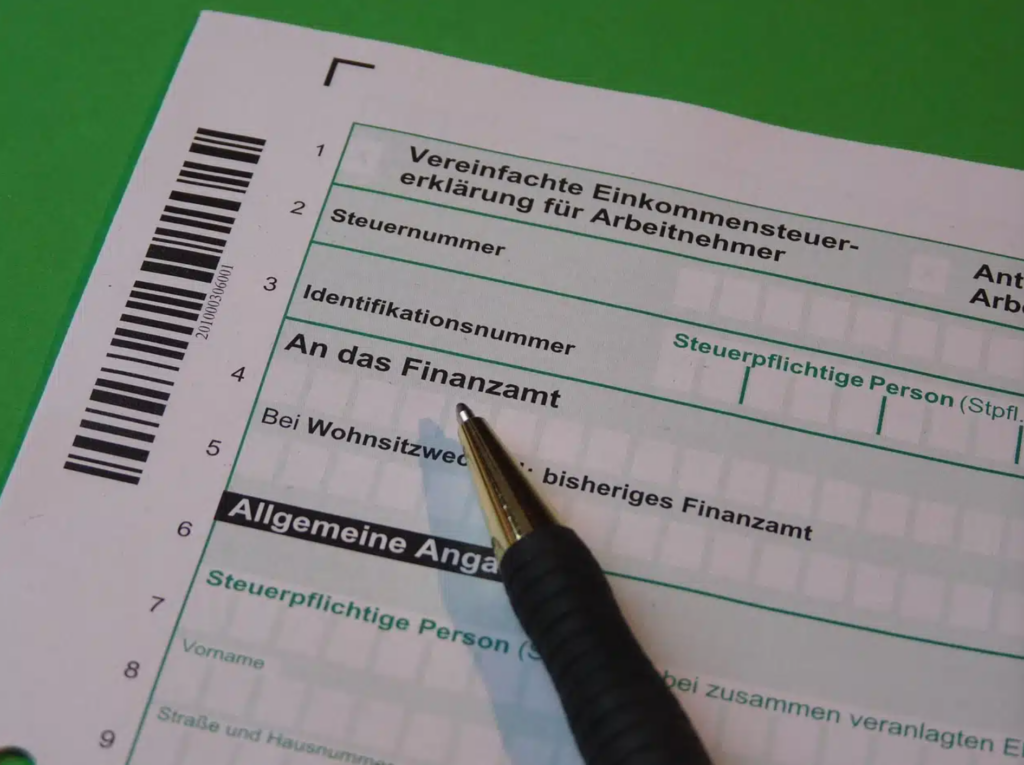
Regardless of whether the course of study takes place in Germany or another country, enrolling in a university is often associated with considerable expenses, particularly when renting an apartment or regular travel to a city several or even dozens of kilometers away from the place of residence is necessary. However, the German tax system provides certain reliefs for students in Germany, especially the possibility to claim specific study-related expenses in the tax return. This article discusses which expenses can be included in the annual tax return, thereby reducing the tax burden vis-à-vis the tax authority. Further explanations are provided below.
When is the deduction of study costs in Germany possible and what does it look like in practice?
A deduction of study costs from taxes is only possible if taxable income was generated in the relevant year. These expenses are classified as special expenses and are limited to €6,000 per year.
However, it is essential: study costs up to €6,000 can be deducted as special expenses. If this does not concern the first course of study but an additional one related to professional activity, the deduction can be claimed as income-related expenses (Werbungskosten) – there is no maximum amount in this case.
Therefore, any reimbursement is not made directly by the German tax authority – provided income has been earned, the study-related expenses recorded in the tax return reduce the amount of tax payable.
A simple tax return in 12 minutes?
Choose Taxando!
Study costs and tax in Germany. What can be deducted?
The issue of the tax deductibility of study expenses in Germany has been of great interest to students for years, which is understandable. Numerous questions arise here, including whether tuition fees can be claimed for tax purposes. How does this work in practice? The following section outlines which specific expenses can be considered in the annual tax return.
Deduction of tuition fees from tax
The tax deduction of tuition fees is possible up to a maximum of €6,000 per year (provided these are the only expenses indicated in the return). This is a positive development for students, as semester contributions are among the highest costs incurred during studies – they often amount to several hundred euros per year.
Deduction of study-related expenses for stationery and other work materials
The deduction of tuition fees is not the only option in the tax return vis-à-vis the German tax office. Expenses for stationery can also be claimed. This includes, among other things, ballpoint pens, pencils, or fountain pens. Acquisitions such as staplers, paper clips etc. are also included. Furthermore, expenses for notebooks, paper, or toner for the printer are tax-deductible.
Study-related costs in the tax return: travel by car
When deducting study expenses, travel costs to the university must also be considered. Students enrolled in attendance courses who drive to the university with their own car can deduct a commuter allowance of €0.38 per kilometer driven (one-way) for tax purposes.
In addition to the commuter allowance, students can also claim other travel costs such as monthly tickets for public transport (full reimbursement without limit within the special expenses framework), parking fees at the university or leasing costs for a bicycle/e-bike (up to 50% of the value) for tax purposes. Complete documentation via receipts or invoices is required. In case of joint travel with an accompanying person (e.g., siblings), doubling of the commuter allowance is possible upon submission of a joint ticket or a certificate. These factors particularly increase tax relief for distances over 20 km – online calculators provided by the tax authorities enable precise calculation prior to submission of the tax return.
The majority of students in Germany do not file a tax return, assuming it is pointless without income. However, this is a costly mistake. Students have a privilege that no other taxpayer possesses – they can claim retrospectively for up to seven years, rather than the usual four years. In practice, this means that persons completing their studies today can reclaim expenses for tuition fees, travel, and study materials from the first year of study. The prerequisite is the retention of relevant receipts.
Tax deduction of rent expenses for apartment or room
The course of study is often associated with the necessity to rent an apartment or a room in the university city – fortunately, deduction of rent in the tax declaration is possible. However, it must be noted that this requires incurring at least 10% of the costs at the main place of residence.
Important: Upon returning to the home town, travel expenses can be claimed as described in the preceding section.
Purchase of a computer
Tax-deductible university-related expenses also include the acquisition of a computer. Especially nowadays, studying or completing final papers is hardly conceivable without such a device. However, it should be noted: such a computer can naturally also be used privately, which is why for tax deduction purposes for the acquisition, the flat 50:50 rule is applied, meaning that half of the purchase price is deductible.
What else can be deducted by students for tax purposes?
To reduce the tax burden vis-à-vis the tax authority at the end of the tax year, consideration of the following expenses in the tax return is also recommended:
- Examination fees,
- Fees for courses, for example language courses,
- Acquisition of specialist literature,
- Study loans,
- Expenses in connection with legal proceedings (legal advice when applying for a university place),
- Printing and binding costs for final theses (Bachelor’s, Master’s, Diploma, or doctoral theses),
- Membership fees for student organizations.
It must be noted that travel costs and other study expenses must be carefully documented – receipts, invoices, proof of payment, and attendance lists from the university should be retained to avoid subsequent objections by the tax authority (retroactively possible for up to four years). When preparing the tax return (income tax return) using programs such as Elster, WISO, or SteuerSparbuch, details must be entered in Annex N (for income-related expenses) or Annex Special Expenses – students without income submit the return voluntarily for a refund. Combining these with other benefits, e.g., for parents (child allowance), can increase the refund by several hundred euros. Before submitting the tax return, the use of an online calculator is recommended to check the expected tax refund.
Students and Tax Returns for Previous Years
In conclusion, it is necessary to point out a very important aspect, namely the possibility of submitting retroactive tax returns in Germany. Ordinary taxpayers are entitled to submit a tax return retroactively for up to 4 years – students benefit from a greater advantage – they may submit the tax return to the tax office retroactively for up to a maximum of 7 years.
Uncertainty frequently exists regarding the correct completion of tax returns and the deductibility of study-related expenses. Nowadays, dedicated tax calculation apps, such as Taxando, are available. This user-friendly and intuitive software enables tax returns to be completed within a few minutes as part of the PREMIUM package, with all relevant tax benefits and deductions taken into account.
FAQ
Can students deduct study-related expenses in Germany?
Yes. Students with taxable income can directly deduct study-related costs in the annual tax return. Students without income should also voluntarily submit a return in order to enable a loss carryforward for subsequent years and offset it after graduation against the first income.
How much can be deducted for studies in Germany?
Up to €6,000 per year in the case of initial studies – as special expenses. For second-degree studies related to a profession, the deduction is unlimited and considered business expenses.
What is the difference between special expenses and business expenses in the context of studies?
Special expenses apply to initial studies, have an annual limit of €6,000 and do not result in a loss that can be carried forward. Business expenses refer to a second course of study (e.g., following prior vocational training or a bachelor’s degree) – these are unlimited and can be carried forward to future tax years.
Can the purchase of a computer be deducted for tax purposes as a student?
Yes, but only 50 % of the amount– the tax office assumes that the computer is also used for private purposes. Devices with a value exceeding €800 net are depreciated over 3 years. An invoice in the taxpayer’s name is sufficient for the deduction.
What is the commuter allowance for students with a university commute?
€0.30 per kilometer for the first 20 km and €0.38 from the 21st kilometer onward for a one-way trip. The rate corresponds to that for employees. In addition, students may also deduct tickets for public transport and parking fees at the university.
Can rent in a university town be deducted?
Yes, within the framework of so-called double household management . The requirement is to cover at least 10 % of the expenses for the main residence (e.g., with parents). Deductible expenses include rent, ancillary costs, and travel costs for trips home.
For how many previous years can students submit tax returns in Germany?
Students have a particular advantage – voluntary submission is possible for up to 7 years retroactively, whereas the standard period for taxpayers is 4 years. This means that a person completing studies in 2026 can deduct costs as far back as 2019 and reclaim the tax from the first year of study.
What else can students in Germany deduct for tax purposes?
Tuition fees and semester contributions, tickets for public transportation, office and writing materials, specialist literature, examination fees, language courses, printing costs for theses, interest on student loans, and membership fees in student organizations. All expenses must be substantiated by invoices or receipts.

Maciej Szewczyk
He gained experience as a consultant on IT projects for many international companies. In 2017, he founded the startup taxando GmbH, where he developed the innovative tax app Taxando, which simplifies the filing of annual tax returns.
Maciej Szewczyk combines technological expertise with in-depth knowledge of tax regulations, making him an expert in his field. In his private life, he is a happy husband and father and lives with his family in Berlin.